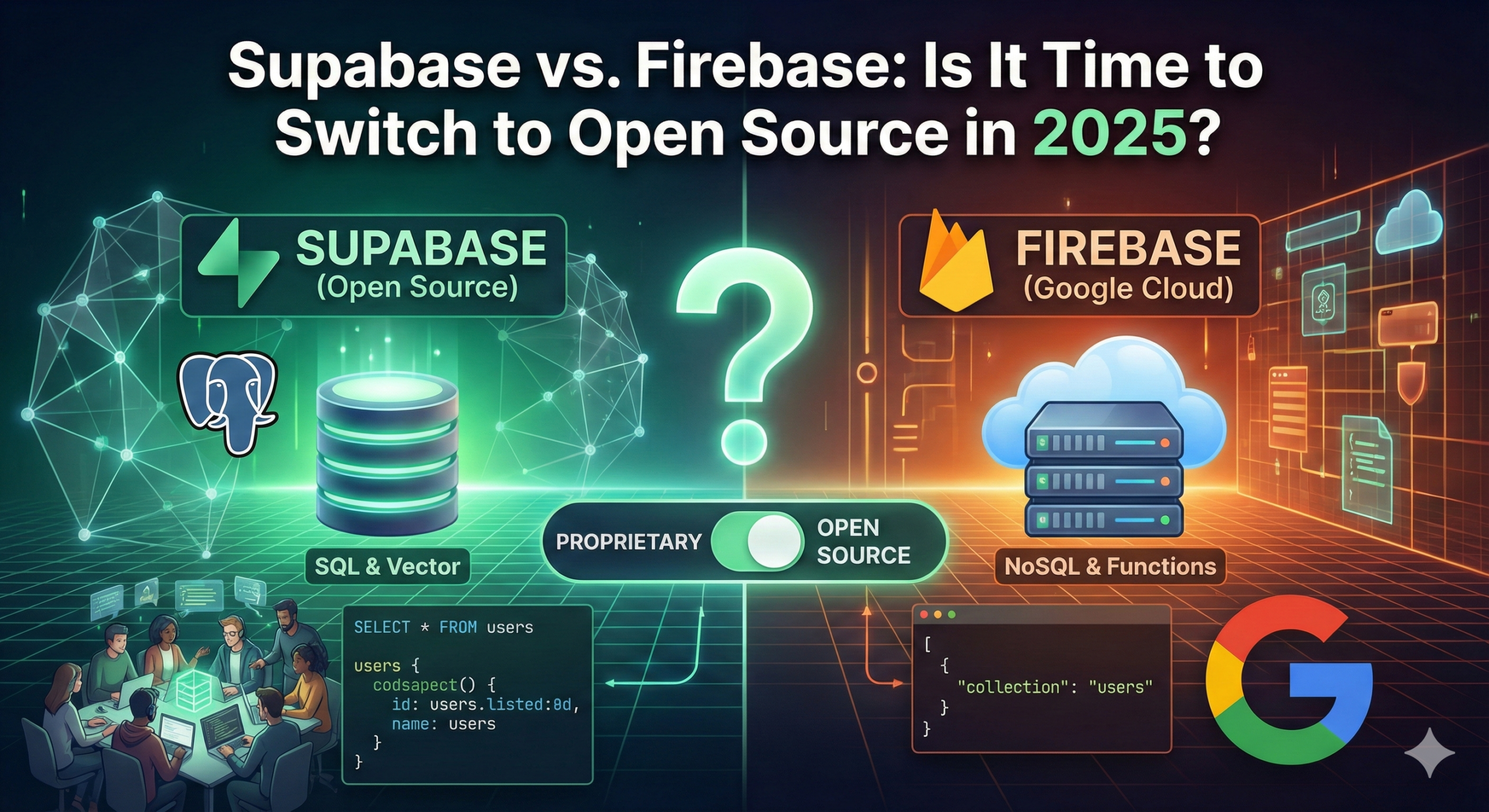
For over a decade, Google’s Firebase has been the default “easy button” for backend development. It promised developers they could forget about servers, scale infinitely, and ship apps in record time. But in 2025, the conversation has shifted.
The rise of Supabase—the self-proclaimed “Open Source Firebase Alternative”—has turned a one-sided monopoly into a fierce rivalry. Developers are no longer just asking “How do I use Firebase?” but rather “Should I migrate to Supabase to avoid vendor lock-in?”
This guide breaks down the Supabase vs. Firebase debate for 2025, comparing their data models, AI capabilities, pricing traps, and developer experience to help you decide if it’s time to make the switch.
The Core Philosophy: SQL vs. NoSQL
The most fundamental difference between these two platforms isn’t their pricing or logo—it is how they handle your data. This single factor will likely dictate your decision.
Firebase (NoSQL Document Store)
Firebase uses Cloud Firestore, a NoSQL document database. It looks like a giant JSON tree.
- Pros: Incredible for rapid prototyping and unstructured data. You don’t need to design a schema upfront.
- Cons: “Relational” data is a nightmare. If you want to build a feature like “Show me all users who bought Product X and live in Y city,” you often have to duplicate data or perform expensive client-side filtering. In 2025, this lack of native joins remains a major bottleneck for complex apps.
Supabase (Relational PostgreSQL)
Supabase is built on top of PostgreSQL, the world’s most popular open-source SQL database.
- Pros: You get the full power of SQL. Joins, foreign keys, and complex queries work natively. It is “Excel on steroids” rather than “JSON folders.”
- Cons: You need to define your schema (tables and columns) before you start adding data. It requires a bit more planning than Firebase’s “dump and run” approach.
2025 Verdict: If your app has complex relationships (e.g., a B2B SaaS, an inventory system, or a social network), Supabase wins hands down. If you are building a simple chat app or a game with independent user records, Firebase remains excellent.
Feature Showdown: AI, Auth, and Realtime
1. AI and Vector Search (The 2025 Frontier)
In 2025, every app is an AI app.
- Supabase: Leads the pack with pgvector. Since Supabase is just Postgres, you can store vector embeddings directly in your database alongside your user data. This makes building RAG (Retrieval-Augmented Generation) pipelines for chatbots incredibly fast and unified.
- Firebase: Offers Genkit and integrations with Vertex AI. While powerful, it often feels like bolting on external Google Cloud services rather than a native database feature.
2. Authentication
- Firebase Auth: Still the gold standard for ease of use. It handles everything from Google Sign-In to Phone Auth with virtually zero code.
- Supabase Auth: Has caught up significantly. It offers Row Level Security (RLS), which is arguably more secure by design. RLS lets you write SQL policies (e.g., “Users can only read rows where
user_idmatches their ID”) that the database engine enforces directly.
3. Realtime Capabilities
- Firebase: Realtime is its DNA. Firestore pushes updates to clients instantly with minimal latency. It handles “presence” (who is online right now) better than almost anything else.
- Supabase: Uses Postgres replication to push changes. It is fast, but for high-frequency updates (like a multiplayer game cursor), Firebase’s WebSocket implementation is often smoother and lighter on the client.
Pricing: The “Bill Shock” Factor
Pricing is the #1 reason developers leave Firebase.
Firebase: The “Pay-as-you-go” Trap
Firebase offers a generous free tier, but once you scale, you pay for reads and writes.
- Scenario: A bug in your code causes a loop that reads a document 1 million times.
- Result: You wake up to a $5,000 bill. There are no hard “caps” to stop your bill from exploding in the Blaze plan, leading to the infamous “Firebase Bill Shock” stories on Reddit.
Supabase: The Predictable Model
Supabase offers a Pro Plan (starting around $25/month in 2025) with predictable limits.
- You pay for storage size (e.g., 8GB of data), not necessarily how many times you read that data.
- If you exceed limits, Supabase usually throttles you or asks you to upgrade, rather than silently draining your bank account.
- Bonus: Because it is open source, you can self-host Supabase on a $5 DigitalOcean droplet if you really need to cut costs.
Comparison Table: At a Glance
| Feature | Firebase (Google) | Supabase (Open Source) |
| Database | NoSQL (Firestore) | SQL (PostgreSQL) |
| Query Power | Low (No native joins) | High (Full SQL support) |
| Realtime | Excellent (Native) | Good (via Replication) |
| AI / Vector | External (Vertex AI extensions) | Native (pgvector) |
| Pricing Model | Usage-based (Risk of spikes) | Fixed Tier + Usage (Predictable) |
| Lock-in | High (Proprietary) | Low (Export to any Postgres) |
| Best For | Mobile Games, Chat, MVPs | SaaS, AI Apps, Data-heavy Tools |
The Vendor Lock-in Argument
This is the strategic differentiator for 2025.
Firebase is a “walled garden.” If you build your entire backend on Firestore, migrating away is painful because your data structure is unique to Firestore’s proprietary format. You cannot just “export” Firestore to a SQL database without massive rewriting.
Supabase is PostgreSQL. If Supabase (the company) disappears tomorrow, or if they double their prices, you can run pg_dump, take your data, and host it on AWS RDS, Azure, or your own server. You own your backend.
When Should You Stick with Firebase?
Despite the hype, Firebase is not dead. It is still the better choice if:
- You are a Flutter/Mobile Dev: Firebase’s integration with Flutter (Google’s UI toolkit) is flawless. Features like Crashlytics, Cloud Messaging (Push Notifications), and App Distribution are critical for mobile apps and are missing from Supabase’s core offering.
- You need “Offline Mode”: Firestore has incredible offline persistence capabilities for mobile devices that just work out of the box.
- You hate SQL: If you just want to throw JSON at a server and get a URL back, Firebase reduces mental friction.
Conclusion: Which One Wins in 2025?
In the battle of Supabase vs. Firebase, the winner depends on your trajectory.
If you are building a consumer mobile app, a game, or a quick prototype where speed to market is everything, Firebase remains the undisputed king of convenience. Its ecosystem for mobile development (Crashlytics, Analytics) is unmatched.
However, if you are building a SaaS platform, an AI-powered tool, or any application where data integrity and complex relationships matter, Supabase is the superior choice for 2025. The combination of PostgreSQL power, vector search for AI, and zero vendor lock-in makes it the safer, more scalable bet for serious businesses.
The Bottom Line: Use Firebase for the client-side magic. Use Supabase for the data muscle.
Relevant Video: … Why Developers Are Switching from Firebase to Supabase in 2025 …
This video provides a great visual breakdown of the “SQL vs NoSQL” mental shift and explains why the developer experience in Supabase is winning over former Firebase users.