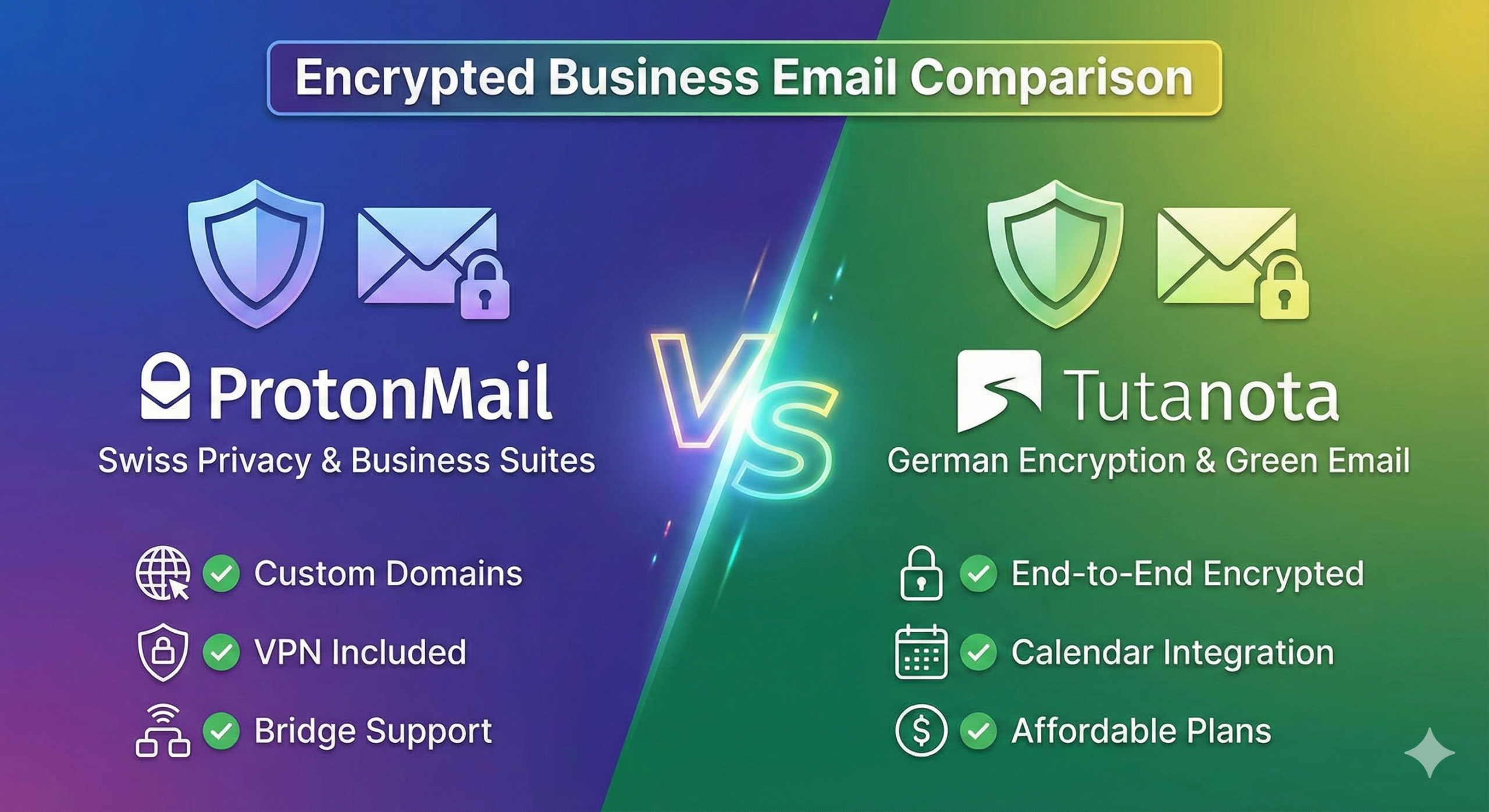
In an era where data breaches are a daily occurrence, securing your business communication is no longer optional—it’s essential. For businesses seeking robust protection beyond what standard providers like Gmail or Outlook offer, encrypted email services are the answer. Two names consistently dominate this space: ProtonMail and Tutanota (now known as Tuta).
Choosing between ProtonMail vs. Tutanota for your business can be challenging, as both offer exceptional security and a privacy-first approach. This guide provides a detailed, head-to-head comparison of their features, pricing, security architectures, and usability to help you decide which platform best aligns with your company’s needs in 2025.
The Core Promise: Privacy and Encryption
Both ProtonMail and Tutanota are built on the principle that your data belongs to you. Unlike mainstream providers that scan your emails for advertising purposes, these services use end-to-end encryption (E2EE). This means your messages are encrypted on your device and can only be decrypted by the intended recipient. Not even the providers themselves have the keys to read your data.
This “zero-knowledge” architecture is the foundation of both platforms, ensuring that your sensitive business communications remain confidential, even in the event of a server breach or a government data request.
ProtonMail: The Swiss-Based Powerhouse
Founded by CERN scientists in Switzerland, ProtonMail benefits from some of the world’s strictest privacy laws. Its infrastructure resides in secure Swiss data centers, outside of US and EU jurisdiction.
ProtonMail uses the open-source PGP encryption standard. This allows for interoperability with other PGP users, even if they don’t use ProtonMail. A key feature for businesses is the Proton Mail Bridge, an application that encrypts emails locally and allows you to use ProtonMail with desktop clients like Outlook, Thunderbird, and Apple Mail.
- Key Strength: Broad ecosystem with integrated VPN, cloud storage (Proton Drive), and calendar, plus compatibility with standard email clients via Bridge.
Tutanota (Tuta): The German Encryption Specialist
Based in Germany, Tutanota operates under strict EU data protection regulations (GDPR). While Germany is part of the “14 Eyes” intelligence-sharing alliance, Tutanota’s zero-knowledge architecture means they have no data to hand over, even if compelled by a court order.
Tutanota distinguishes itself by using a hybrid encryption method that combines standard algorithms (AES and RSA) with pioneering support for quantum-resistant cryptography. This forward-looking approach aims to protect your data against future threats from quantum computers. Unlike ProtonMail, Tutanota encrypts subject lines and the entire address book, offering a slightly broader scope of encryption by default.
- Key Strength: Encrypts subject lines and contacts by default, offers post-quantum cryptography protection, and provides excellent value for money.
Feature Comparison for Businesses
When evaluating ProtonMail vs. Tutanota for business use, features like custom domains, user management, and collaboration tools are critical.
Custom Domains and Aliases
Both providers allow you to use your own business domain (e.g., yourname@yourcompany.com), which is essential for professional branding.
- Tutanota shines here by offering support for unlimited custom domains on its business plans. It also includes a “catch-all” feature, which collects any email sent to your domain, even if the specific address doesn’t exist.
- ProtonMail limits the number of custom domains depending on your plan tier. While higher tiers offer more, Tutanota provides more flexibility in this area for a lower price point.
Usability and Apps
ProtonMail generally offers a more polished and modern user interface across its web and mobile apps. Its acquisition of SimpleLogin also provides powerful email alias capabilities to protect your primary address.
Tutanota has a simpler, more utilitarian interface. It offers dedicated desktop apps for Windows, macOS, and Linux, which some businesses prefer over running email in a browser tab. ProtonMail’s desktop experience relies on the Bridge application integrated with third-party clients.
Pricing and Plans
Pricing is often a deciding factor. Tutanota is generally the more budget-friendly option for businesses.
| Feature | ProtonMail Business (Mail Essentials) | Tutanota Business (Revolutionary) |
| Starting Price (per user/mo) | ~$7.99 (billed annually) | ~$3.60 (billed annually) |
| Storage | 15 GB | 20 GB |
| Email Addresses | 10 per user | 15 per user |
| Custom Domains | 3 | Unlimited |
| Encryption | PGP (Subject lines not encrypted) | Hybrid & Post-Quantum (Subject lines encrypted) |
| Desktop Clients | Via Bridge (Outlook, etc.) | Dedicated Desktop Apps |
| Ecosystem | VPN, Drive, Calendar included | Calendar included |
Note: Prices and plan details are subject to change. Always check the official websites for the most current information.
While ProtonMail’s base business plan is more expensive, it includes access to their VPN and larger storage pool across their ecosystem, which can add significant value. Tutanota’s pricing is straightforward and highly competitive for pure email needs.
Pros and Cons Summary
ProtonMail
Pros:
- Mature and polished user ecosystem (Mail, Drive, VPN, Calendar).
- Based in Switzerland with strong privacy laws.
- Proton Mail Bridge allows use with Outlook, Apple Mail, etc.
- Interoperable with standard PGP.
Cons:
- More expensive than Tutanota.
- Does not encrypt subject lines by default.
- Limits on custom domains in lower tiers.
Tutanota (Tuta)
Pros:
- More affordable pricing for businesses.
- Encrypts subject lines and contacts by default.
- Offers quantum-resistant encryption.
- Unlimited custom domains on business plans.
- Dedicated desktop applications.
Cons:
- Based in Germany (a “14 Eyes” country), though encryption mitigates this risk.
- Not compatible with standard email clients (no IMAP/POP3/SMTP support).
- User interface is less modern and feature-rich.
Conclusion
The choice in the ProtonMail vs. Tutanota battle ultimately depends on your business priorities.
If your company needs a comprehensive privacy suite that includes email, VPN, and cloud storage, and you rely on desktop clients like Outlook, ProtonMail is the superior, albeit pricier, choice. Its polished ecosystem and Swiss jurisdiction are major draws for many enterprises.
On the other hand, if your primary goal is to secure business email at the most affordable price point, with future-proof encryption that includes subject lines, Tutanota is an excellent alternative. Its support for unlimited custom domains makes it particularly attractive for growing businesses managing multiple brands.
Both platforms are outstanding choices that are vastly superior to conventional email providers in terms of security and privacy. By migrating to either one, you are taking a significant step in protecting your business communications in 2025 and beyond.